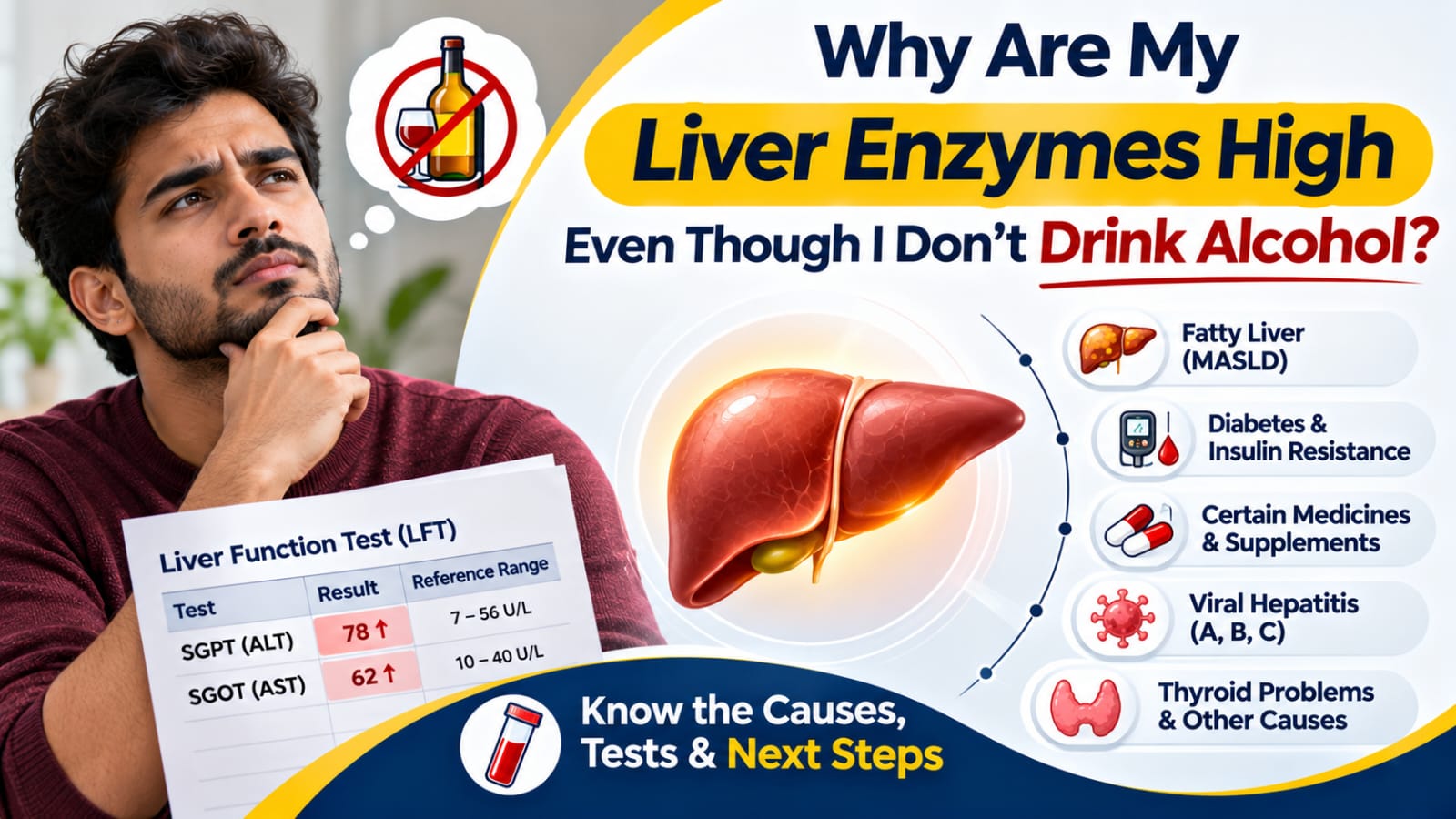
You recently had a routine blood test, and your report shows elevated SGPT (ALT) or SGOT (AST). Naturally, you start wondering what could be wrong with your liver.
But there’s one thing you don’t understand: you don’t drink alcohol.
So why are your liver enzymes high?
Many people assume that elevated liver enzymes are always caused by alcohol consumption. However, that’s not true. Several conditions unrelated to alcohol can affect your liver and cause changes in blood test results.
These include fatty liver disease, diabetes, excess body weight, certain medications, viral infections and other medical conditions.
Sometimes, elevated liver enzymes are temporary. In other cases, they may indicate an underlying condition that needs medical attention.
Let’s understand what elevated liver enzymes mean, why they can occur even if you don’t drink alcohol, and which tests a doctor may recommend.
What Are Liver Enzymes?
Liver enzymes are proteins that help your liver perform different chemical processes.
Two commonly measured liver enzymes are:
- SGPT (ALT – Alanine Aminotransferase): Found mainly in the liver. When liver cells are irritated or damaged, ALT can leak into the bloodstream, causing its level to increase.
- SGOT (AST – Aspartate Aminotransferase): Found in the liver as well as muscles, heart and other tissues. Elevated AST is not necessarily caused by a liver problem.
These enzymes are commonly included in liver-related blood investigations.
When their levels are higher than the laboratory reference range, it may indicate liver cell injury or inflammation. However, the result alone cannot identify the exact cause.
One important thing to understand: ALT and AST are markers of possible cell injury, not direct measurements of how well your liver is functioning.
Other measurements, such as bilirubin, albumin and certain clotting tests, provide additional information about liver health.
Why Are My Liver Enzymes High If I Don’t Drink Alcohol?
Alcohol is only one possible cause of elevated liver enzymes. Several other factors can affect your liver.
Here are some common possibilities.
1. Fatty Liver Disease (MASLD)
One important cause of elevated liver enzymes in people who do not drink alcohol is fatty liver disease.
The condition is now commonly called Metabolic Dysfunction-Associated Steatotic Liver Disease (MASLD). It was previously known as non-alcoholic fatty liver disease (NAFLD).
It occurs when excess fat accumulates in the liver alongside one or more metabolic risk factors.
These may include:
- Excess body weight, particularly around the abdomen
- Type 2 diabetes
- Insulin resistance
- High triglyceride levels
- High blood pressure
- Metabolic syndrome
Many people with fatty liver disease do not experience noticeable symptoms.
However, some may have elevated ALT or AST levels during routine blood testing.
If the condition progresses to liver inflammation and scarring, it can become more serious.
2. Diabetes and Insulin Resistance
Your liver plays an important role in regulating blood glucose and storing energy.
When your body develops insulin resistance, it may also increase the risk of fat accumulating in the liver.
People with type 2 diabetes are more likely to develop MASLD.
In some cases, this may be associated with elevated liver enzymes.
If your liver enzymes are high and you also have diabetes, high blood sugar or excess abdominal fat, your doctor may consider evaluating your metabolic and liver health together.
3. Being Overweight or Having High Triglycerides
Excess body fat, particularly around the waist, can increase the risk of fat accumulation in the liver.
Similarly, elevated triglyceride levels may be associated with metabolic dysfunction and fatty liver disease.
You may have no obvious symptoms, which is why liver enzyme abnormalities are sometimes discovered during routine health check-ups.
Maintaining a healthy weight, eating a balanced diet and staying physically active can help improve metabolic health.
4. Certain Medicines and Supplements
Some prescription medicines, over-the-counter drugs and herbal supplements can affect liver cells.
Examples include:
- Certain antibiotics
- Some anti-seizure medicines
- Certain cholesterol-lowering medicines
- Some anti-tuberculosis medicines
- Paracetamol, particularly in excessive doses
- Certain herbal and bodybuilding supplements
This type of liver injury is sometimes called drug-induced liver injury.
The effect depends on the medicine, dose, duration of use and individual health factors.
If your liver enzymes increased after starting a new medicine or supplement, inform your doctor.
Do not stop prescribed medicines on your own. Your doctor can review the possible side effects and decide whether any changes are necessary.
5. Viral Hepatitis
Certain viral infections can directly affect the liver and cause elevated liver enzymes.
Important examples include:
- Hepatitis A: Usually spreads through contaminated food or water.
- Hepatitis B: Can spread through infected blood and certain body fluids.
- Hepatitis C: Commonly spreads through infected blood.
Hepatitis infections may cause symptoms such as:
- Fatigue
- Loss of appetite
- Nausea
- Abdominal discomfort
- Dark urine
- Yellowing of the skin or eyes
However, some people with hepatitis B or C may not experience noticeable symptoms for years.
Depending on your medical history and risk factors, your doctor may recommend specific hepatitis screening tests.
6. Thyroid Problems
Your thyroid gland helps regulate metabolism throughout the body.
Certain thyroid disorders, particularly hypothyroidism, can be associated with abnormal liver enzyme levels.
This relationship may involve changes in metabolism, fatty liver risk and other underlying processes.
If you have symptoms such as persistent tiredness, unexplained weight gain, constipation or unusual sensitivity to cold, your doctor may consider thyroid function testing.
7. Autoimmune Liver Diseases
Sometimes, the immune system mistakenly attacks healthy liver cells or structures within the liver.
Examples include:
- Autoimmune hepatitis
- Primary biliary cholangitis (PBC)
- Primary sclerosing cholangitis (PSC)
These conditions can cause abnormal liver-related blood test results.
They may require specialised blood investigations, imaging and, in selected cases, further specialist evaluation.
They are less common than metabolic fatty liver disease but are important possibilities when the clinical findings suggest them.
8. Intense Exercise and Muscle Injury
Not every increase in AST or ALT comes from the liver.
AST is also present in skeletal muscles. Intense exercise, muscle injury and certain muscle disorders can increase AST levels and sometimes ALT levels as well.
For example, strenuous weight training shortly before a blood test may affect some enzyme results.
If muscle injury is suspected, a doctor may recommend a Creatine Kinase (CK) test to help investigate the possibility.
This is one reason why liver enzyme results should always be interpreted in the context of your recent activities and medical history.
Does High SGPT or SGOT Always Mean Liver Damage?
No.
An elevated liver enzyme result does not automatically mean that your liver is seriously damaged.
The significance depends on several factors:
- How high the enzyme levels are
- Whether ALT, AST or both are elevated
- Whether other liver-related parameters are abnormal
- Whether the levels remain elevated over time
- Your symptoms, medical history and medication use
For example, a mild increase may occur temporarily after an illness, medication exposure or strenuous exercise.
On the other hand, persistently elevated enzymes may require further investigation.
It is also important to understand that people with advanced liver disease can sometimes have normal or only mildly elevated ALT and AST levels.
Therefore, normal enzyme levels alone cannot rule out every liver condition.
Which Tests May Be Needed If Your Liver Enzymes Are High?
If your SGPT or SGOT levels are elevated, your doctor may recommend additional investigations to understand the underlying cause.
The choice of tests depends on your initial report, symptoms, medical history and risk factors.
1. Liver Function Test (LFT)
An LFT is a group of blood tests used to assess different aspects of liver health.
It commonly includes measurements such as:
- SGPT (ALT)
- SGOT (AST)
- Alkaline Phosphatase (ALP)
- Bilirubin
- Albumin
- Total protein
Some liver-related evaluations may also include other measurements, such as GGT and PT/INR.
These results help doctors assess patterns of liver enzyme elevation and look for other abnormalities. The exact components of an LFT panel can vary between laboratories.
2. Hepatitis Screening Tests
If viral hepatitis is suspected, your doctor may recommend specific tests.
These may include:
- HBsAg for hepatitis B screening
- Anti-HCV antibodies for hepatitis C screening
- Additional confirmatory tests when required
The exact tests depend on your medical history and the suspected infection.
3. Fasting Blood Glucose and HbA1c
Since diabetes and insulin resistance are associated with fatty liver disease, doctors may assess your blood sugar status.
- Fasting Blood Glucose: Measures blood glucose after a period of fasting.
- HbA1c: Estimates your average blood glucose over approximately the previous two to three months.
These tests may help identify diabetes or prediabetes.
4. Lipid Profile
A lipid profile measures different types of fats in your blood, including:
- Total cholesterol
- LDL cholesterol
- HDL cholesterol
- Triglycerides
Abnormal triglyceride and cholesterol levels may be associated with metabolic risk factors and fatty liver disease.
5. Ultrasound of the Abdomen
A doctor may recommend an abdominal ultrasound when fatty liver or another structural liver condition is suspected.
It can help identify:
- Fat accumulation in the liver
- Liver enlargement
- Certain structural abnormalities
- Some other abdominal conditions
However, a routine ultrasound may not detect mild fatty liver and cannot reliably determine the degree of liver inflammation or scarring.
Further assessment may be needed depending on the findings.
6. Additional Investigations When Required
If initial tests do not explain the elevated enzymes, your doctor may consider more specific investigations.
These could include:
- Thyroid Function Test
- Autoimmune markers
- Ferritin and iron studies
- Creatine Kinase (CK)
- Other specialised liver-related tests
Not everyone with elevated liver enzymes needs all these investigations.
What Should You Do If Your SGPT or SGOT Is High?
If your blood report shows elevated liver enzymes, avoid jumping to conclusions.
Here are some practical steps:
- Consult your doctor: Discuss the result and your medical history rather than interpreting the numbers in isolation.
- Review your medicines: Inform your doctor about all prescription medicines, painkillers, supplements and herbal products you use.
- Avoid alcohol: Even if alcohol was not the cause, avoiding it is sensible while the abnormal result is being evaluated.
- Maintain a healthy weight: If you are overweight, gradual and sustainable weight management may help reduce metabolic risk.
- Improve your diet: Include vegetables, fruits, whole grains and suitable protein sources. Limit excessive sugary drinks and highly processed foods.
- Stay physically active: Regular exercise supports metabolic health and may help reduce liver fat.
- Follow up when advised: Your doctor may recommend repeating blood tests or undergoing further investigations.
Do not start liver detox products or herbal supplements to reduce SGPT or SGOT without medical advice. Some products marketed for liver health can actually cause liver injury.
When Should You Be Concerned About High Liver Enzymes?
An isolated mild elevation does not always indicate an emergency. However, certain symptoms require prompt medical attention.
Consult a doctor if you experience:
- Persistent fatigue
- Unexplained loss of appetite
- Repeated nausea or vomiting
- Ongoing discomfort in the upper right side of your abdomen
- Unexplained weight loss
- Persistently abnormal liver enzyme results
Seek urgent medical attention if you notice:
- Yellowing of the skin or eyes
- Dark urine with pale or clay-coloured stools
- Severe abdominal pain
- Vomiting blood or passing black, tar-like stools
- New confusion, unusual drowsiness or difficulty staying awake
- Significant abdominal swelling
These symptoms may indicate a more serious liver or other medical condition and should not be ignored.
Frequently Asked Questions
1. Can liver enzymes be high even if I never drink alcohol?
Yes. Fatty liver disease, diabetes, obesity, viral hepatitis, certain medicines, autoimmune conditions and other health problems can cause elevated liver enzymes even in people who never consume alcohol.
2. Which is more important, SGPT or SGOT?
Both provide useful information, but they have different interpretations. ALT is more closely associated with liver cells, while AST is also found in muscles and other tissues. Doctors generally interpret both values alongside other test results.
3. Can fatty liver cause high SGPT without symptoms?
Yes. Many people with fatty liver disease have no noticeable symptoms. Elevated SGPT or SGOT may be discovered during routine blood testing.
4. Can high SGPT return to normal?
Yes, depending on the underlying cause. Liver enzyme levels may return to normal when a temporary cause resolves or an underlying condition is appropriately managed. However, normal enzyme levels do not necessarily mean that every liver condition has disappeared.
5. Should I stop eating oily food if my liver enzymes are high?
You do not necessarily need to eliminate all fats. Instead, focus on a balanced diet, appropriate portion sizes and limiting excessive fried foods, sugary drinks and highly processed foods. Your dietary plan should reflect your overall health and any diagnosed condition.
6. Is an ultrasound enough to detect fatty liver?
An ultrasound can identify many cases of fatty liver, but it may miss mild fat accumulation and cannot reliably assess liver inflammation or fibrosis. Your doctor may recommend additional evaluation depending on your risk factors and test results.
Get the Right Liver Investigations with CPL Diagnostics
Finding elevated SGPT or SGOT levels can be concerning, especially when you do not drink alcohol and cannot identify the reason.
However, alcohol is only one of several possible causes of abnormal liver enzyme results.
The right approach is to understand the pattern of abnormalities, identify possible risk factors and investigate the underlying cause when necessary.
At CPL Diagnostics (Calcutta Path Labs), we provide diagnostic laboratory services to support patients and healthcare professionals.
Depending on your doctor’s recommendation, relevant investigations may include:
- Liver Function Test (LFT)
- SGPT (ALT)
- SGOT (AST)
- Hepatitis screening tests
- Fasting Blood Glucose
- HbA1c
- Lipid Profile
- Thyroid Function Test
Not everyone with elevated liver enzymes needs every test listed above. Your doctor can help determine which investigations are appropriate.
Explore diagnostic services: https://www.cpl.net.in/
For test-related enquiries and appointments: +91 94330 26662
CPL Diagnostics serves patients across Kolkata, Asansol and Patna. Contact our team to confirm test availability, sample collection arrangements and reporting timelines for your location.
Medical Disclaimer: This article is intended for general health education and does not replace professional medical advice, diagnosis or treatment. Elevated liver enzymes should be interpreted by a qualified healthcare professional in the context of your symptoms, medical history and other investigations. Do not stop prescribed medicines or start supplements without medical advice.