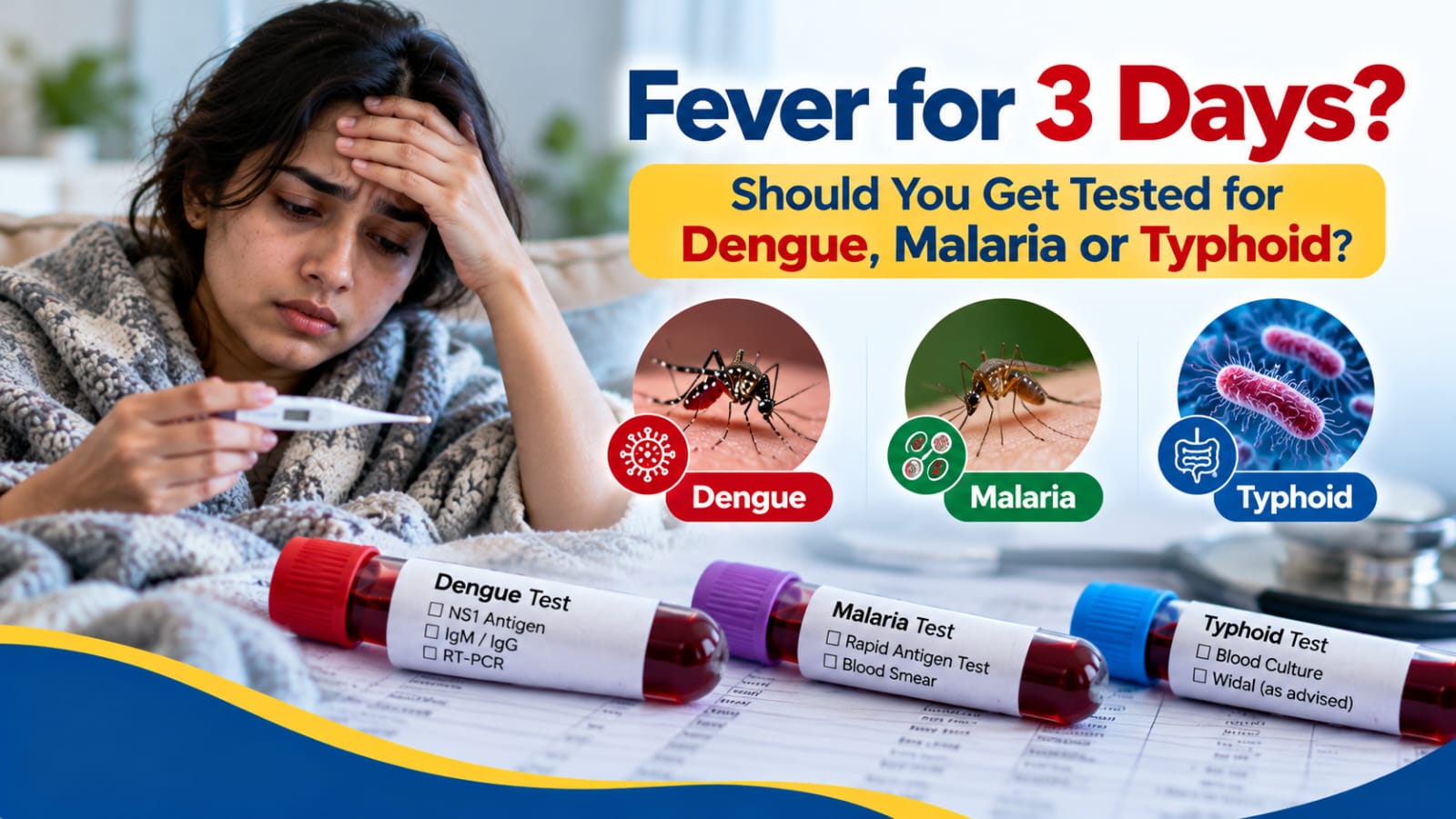
Have you had a fever for three days, and the temperature still isn’t coming down? If you’re experiencing persistent fever, headache, body aches, chills, weakness, or loss of appetite, you may be wondering whether you need a dengue, malaria, or typhoid test.
These infections can cause similar symptoms, particularly in India, where several mosquito-borne and other infectious diseases can cause fever. However, symptoms alone cannot reliably distinguish dengue, malaria, and typhoid. The appropriate tests depend on your symptoms, medical history, local infection patterns, and how many days you have had a fever.
At CPL Diagnostics, we understand the importance of timely diagnostic testing in helping healthcare professionals investigate persistent fever and make informed decisions about patient care.
Is a Fever Lasting 3 Days a Reason to Get Tested?
A fever lasting three days does not automatically mean you have dengue, malaria, or typhoid. Viral infections and several other conditions can also cause prolonged fever.
However, if your fever persists, keeps returning, or is accompanied by other symptoms, it is sensible to seek medical evaluation rather than continuing to self-medicate.
A healthcare professional may consider diagnostic testing based on factors such as:
- Your temperature and how long you have had a fever.
- Whether you experience chills, headache, body aches, vomiting, diarrhoea, or abdominal discomfort.
- Recent mosquito exposure, travel, or possible exposure to contaminated food or water.
- Your medical history and any medicines you have already taken.
- Whether you have warning signs that require urgent assessment.
You do not necessarily need all three tests. Testing should be guided by a clinical assessment.
Dengue vs Malaria vs Typhoid: How Are the Symptoms Different?
Although there can be overlap, some symptoms and exposure histories may help a healthcare professional decide which infections to investigate.
Feature| Dengue| Malaria| Typhoid
Common symptoms| Fever, headache, body aches, nausea, sometimes rash| Fever, chills, headache, weakness, sometimes sweating| Persistent fever, headache, weakness, abdominal discomfort, constipation or diarrhoea
Typical exposure| Bite from an infected mosquito| Bite from an infected mosquito| Usually ingestion of food or water contaminated with the bacteria
Possible tests| Dengue NS1 antigen, molecular testing, or antibody tests, depending on timing| Malaria rapid diagnostic test or blood smear microscopy| Blood culture; other tests may be considered depending on the clinical situation
Important consideration| Warning signs can develop as the fever subsides| Prompt diagnosis and treatment are important| Antibiotics taken before blood collection may reduce the chance of a positive blood culture
These are general patterns, not diagnostic rules. None of these infections can be confirmed or excluded by symptoms alone.
- Should You Get a Dengue Test After 3 Days of Fever?
Dengue may cause fever, severe headache, pain behind the eyes, muscle and joint pain, nausea, and sometimes a rash. Not everyone experiences all these symptoms.
If dengue is suspected, the timing of testing matters.
Which dengue test is suitable on Day 3?
During the early phase of illness, healthcare professionals may recommend a dengue NS1 antigen test or a molecular test such as RT-PCR, depending on availability and the clinical situation.
- NS1 antigen test: Detects a dengue viral protein and is useful during the early stage of infection, particularly within the first seven days.
- Dengue RT-PCR: Detects viral genetic material and can help confirm an acute infection during the early phase.
- Dengue IgM antibody test: Detects the body’s immune response and becomes more useful as the illness progresses. It may be used alongside early tests or later in the course of illness.
A negative early dengue test does not always rule out infection. A healthcare professional may recommend additional or repeat testing if symptoms and clinical findings continue to suggest dengue.
Is a platelet count enough to diagnose dengue?
No. A complete blood count (CBC), including platelet count and haematocrit, may help clinicians assess a patient’s condition and monitor changes when dengue is suspected.
However, a low platelet count does not by itself confirm dengue, and a normal platelet count does not necessarily exclude early infection. Specific dengue testing and clinical assessment are important.
Important: In dengue, warning signs may appear around the time the fever starts to subside. Do not assume that a falling temperature always means the illness is improving.
- Should You Get a Malaria Test After 3 Days of Fever?
Malaria is an infection caused by parasites transmitted through the bite of an infected female Anopheles mosquito. Symptoms can include fever, chills, headache, muscle aches, weakness, nausea, and vomiting.
Some people experience episodes of fever and chills, but malaria does not always follow a predictable fever pattern. Waiting for a particular pattern before seeking care can delay diagnosis.
Which malaria test should you take?
A healthcare professional may recommend one of the following:
- Malaria rapid diagnostic test (RDT): Detects specific malaria antigens in a blood sample and can provide results relatively quickly.
- Peripheral blood smear microscopy: Examines a blood sample under a microscope to identify malaria parasites and, in suitable circumstances, help determine the species.
The World Health Organization recommends parasite-based testing by microscopy or a rapid diagnostic test for suspected malaria before antimalarial treatment is given, where testing is available.
If the initial result is negative but malaria remains a strong clinical possibility, further testing may be necessary according to medical guidance.
Do not start antimalarial medication without medical advice. Prompt assessment is particularly important if you have fever with chills, worsening weakness, confusion, breathing difficulties, or other severe symptoms.
- Should You Get a Typhoid Test After 3 Days of Fever?
Typhoid fever is caused by Salmonella Typhi bacteria and is usually transmitted through contaminated food or water.
Symptoms can include persistent fever, headache, fatigue, abdominal discomfort, nausea, constipation, or diarrhoea. However, these symptoms overlap with many other illnesses.
Typhoid cannot be reliably diagnosed from the fever pattern or symptoms alone.
Which typhoid test is most useful?
Blood culture is the main diagnostic test for typhoid fever. It looks for the bacteria in a blood sample and may also help determine which antibiotics are likely to be effective.
When typhoid is suspected, the healthcare professional may recommend collecting a blood culture before antibiotics are started, when feasible. Antibiotic treatment before sample collection can reduce the likelihood of detecting the bacteria.
Other tests, including serological tests such as Widal, may be used in some settings. However, Widal results can be difficult to interpret because of false positives, background antibodies, and limitations in distinguishing current infection from previous exposure. It should not be relied on alone to confirm typhoid.
The choice of test depends on the clinical situation, local laboratory practices, and the stage of illness.
- Do You Need a CBC or Other Blood Tests Alongside These Tests?
Depending on your symptoms and examination findings, your healthcare professional may recommend additional investigations.
A complete blood count (CBC) can measure haemoglobin, white blood cells, platelets, and other blood cell parameters. These findings may help assess your overall condition and support clinical decision-making.
Other tests may be recommended when there is a reason to investigate dehydration, organ involvement, or alternative causes of fever.
However, no single CBC result can reliably distinguish dengue, malaria, and typhoid. The results must be interpreted alongside the specific diagnostic tests and your clinical assessment.
Which Test Should You Take First?
There is no universal test package for everyone with a three-day fever. The right investigation depends on the likely cause and the timing of symptoms.
Your situation| What a healthcare professional may consider
Fever with severe body aches, headache, or rash| Dengue testing, depending on the illness day and clinical findings
Fever with chills and possible mosquito exposure in a malaria-risk area| Malaria RDT or blood smear microscopy
Persistent fever with abdominal symptoms or possible contaminated food or water exposure| Typhoid evaluation, often including blood culture
Fever with no clear cause or additional symptoms| Examination and targeted investigations based on the suspected cause
These examples are intended to explain the decision-making process, not to help you diagnose yourself. Other infections may need to be considered, and more than one test may sometimes be appropriate.
What Should You Do While Waiting for Test Results?
If you have had a fever for three days, arrange a medical assessment, especially if the fever persists or you are getting worse.
In the meantime:
- Drink fluids regularly, unless a healthcare professional has advised you to restrict fluids.
- Rest and monitor your temperature and other symptoms.
- Ask a healthcare professional or pharmacist which fever medicine is appropriate for you.
- Avoid taking leftover antibiotics or starting antibiotics without medical advice.
- If dengue is possible, avoid aspirin and ibuprofen unless specifically directed by a clinician, because these medicines can increase bleeding risk.
- Follow the laboratory’s instructions for sample collection and any follow-up testing.
Do not delay medical care while waiting to arrange a blood test.
When Should You Seek Urgent Medical Attention?
A persistent fever sometimes requires prompt treatment, and certain symptoms may indicate a serious illness.
Seek urgent medical care if you develop:
- Severe abdominal pain or repeated vomiting.
- Bleeding from the nose or gums, blood in vomit, or black or bloody stools.
- Difficulty breathing, confusion, fainting, or unusual drowsiness.
- Very little urine or signs of significant dehydration.
- Severe weakness or an inability to drink fluids.
- Cold, clammy skin or rapidly worsening symptoms.
If dengue is suspected, seek immediate assessment for warning signs even if your fever is coming down.
Frequently Asked Questions
Is three days of fever enough to confirm dengue?
No. Fever duration alone cannot confirm dengue. A healthcare professional may recommend NS1 antigen testing, molecular testing, or antibody testing depending on the day of illness and clinical findings.
Can I test for dengue, malaria, and typhoid on the same day?
Yes, it is possible to perform multiple investigations on the same day when clinically indicated. However, not everyone needs all three. Your healthcare professional should select the tests based on your symptoms, exposure history, and the likely causes of fever.
Can a dengue test be negative on Day 3?
Yes. Although NS1 antigen and molecular tests can help detect early dengue, a negative result does not always rule it out. Further evaluation or repeat testing may be appropriate if dengue remains suspected.
Is the Widal test enough to confirm typhoid?
No. Widal results can be difficult to interpret and may be positive for reasons other than a current typhoid infection. Blood culture is the main diagnostic test for typhoid fever, and a clinician should interpret all findings in context.
Should I wait until Day 5 to get tested?
Do not wait for an arbitrary number of days if you are unwell or your symptoms are worsening. Some tests are useful early in the illness, and prompt assessment is important when dengue, malaria, or another significant infection is possible.
Conclusion
A fever lasting three days can have several causes, including dengue, malaria, typhoid, and other infections. Because their symptoms often overlap, choosing the right diagnostic test requires more than looking at the temperature or the number of days you have been ill.
Dengue NS1 antigen or molecular testing may be useful early in the illness, malaria can be investigated through rapid testing or blood smear microscopy, and blood culture is central to diagnosing typhoid fever.
At CPL Diagnostics, we recognise the role of appropriate laboratory testing in supporting healthcare professionals as they investigate persistent fever. If you or a family member has had a fever for three days, consult a qualified healthcare professional to determine the appropriate tests and next steps.
Learn more about our diagnostic services: Visit “CPL Diagnostics” (https://www.cpl.net.in/) to explore our laboratory services.
Medical disclaimer: This article is for general educational purposes only and does not replace professional medical advice, diagnosis, or treatment. Test selection and interpretation should be guided by a qualified healthcare professional.