Blood sugar testing is an important part of detecting diabetes, identifying prediabetes, and monitoring glucose levels over time. However, when you look at available tests, you may wonder: Should you choose an HbA1c test or a fasting blood sugar test?
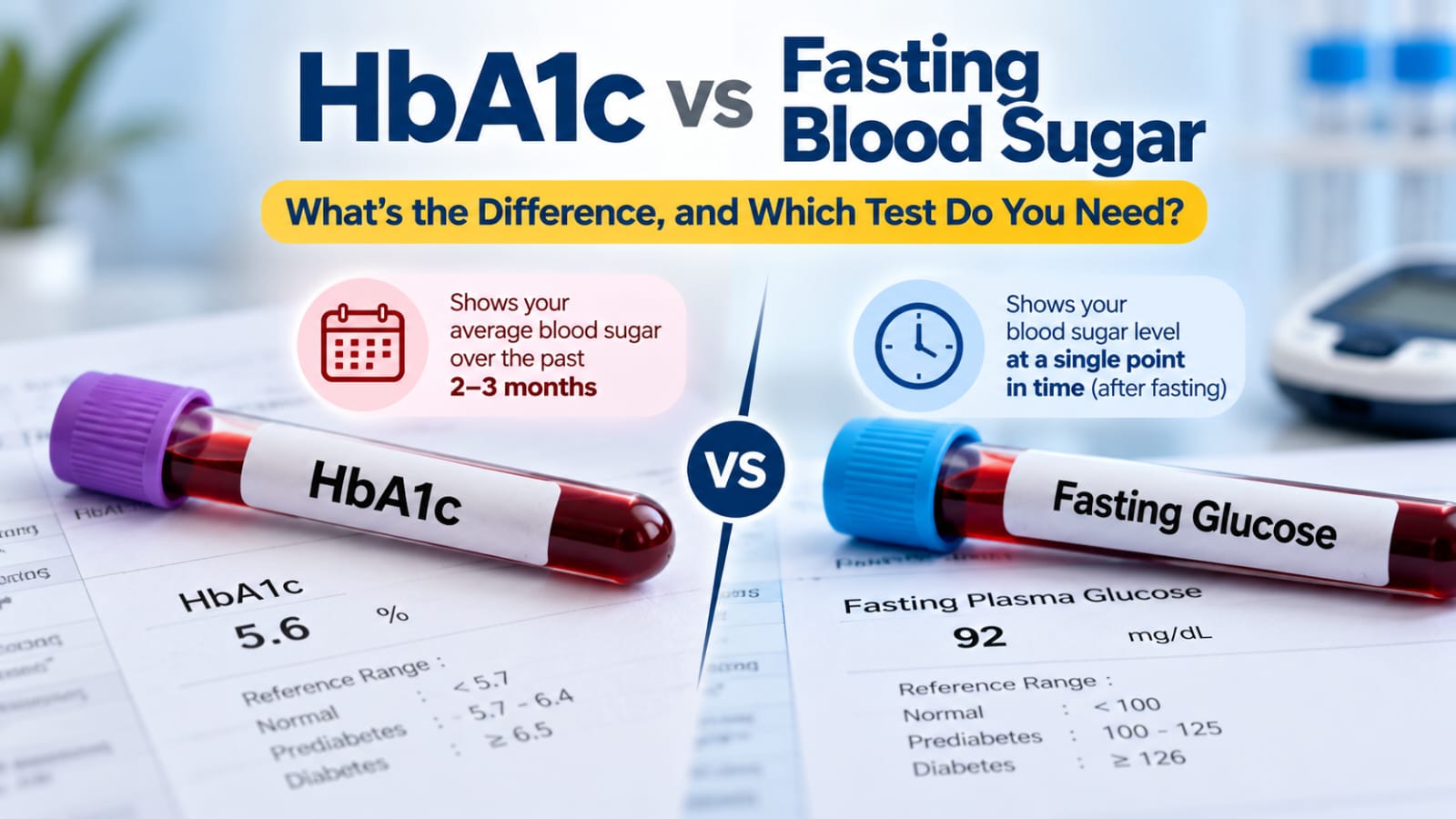
Although both tests help assess blood glucose, they measure different things. An HbA1c test provides an estimate of your average blood sugar over the previous two to three months, while a fasting blood sugar test measures your glucose level at a single point in time after an overnight fast.
Understanding the difference can help you have a more informed discussion with your healthcare professional about which test is appropriate for your needs.
At CPL Diagnostics, we believe that clear information about diagnostic testing helps people make better-informed decisions about their health.
What Is an HbA1c Test?
The HbA1c test, also known as the glycated haemoglobin test, measures the percentage of haemoglobin in your red blood cells that has glucose attached to it.
Haemoglobin is the protein responsible for carrying oxygen throughout the body. When glucose circulates in your bloodstream, some of it attaches to haemoglobin. Because red blood cells remain in circulation for approximately three months, HbA1c provides an estimate of your average blood sugar levels over the preceding two to three months.
Unlike a fasting blood sugar test, an HbA1c test generally does not require you to fast.
What Is the HbA1c Test Used For?
Healthcare professionals may use HbA1c to:
- Screen for prediabetes and type 2 diabetes.
- Help diagnose diabetes when appropriate diagnostic criteria are met.
- Monitor longer-term blood sugar control in people living with diabetes.
- Evaluate how blood glucose levels have changed over time.
HbA1c is useful because it provides a broader picture of blood sugar levels rather than measuring glucose at just one moment.
However, certain conditions—including some forms of anaemia, haemoglobin disorders, recent blood loss or transfusion, and pregnancy-related factors—can affect the accuracy or interpretation of HbA1c. A healthcare professional may recommend a different test in these circumstances.
What Is a Fasting Blood Sugar Test?
A fasting blood sugar test, also called fasting plasma glucose (FPG), measures the amount of glucose in your blood after you have gone without food for a specified period.
For this test, you generally need to fast for at least eight hours before the blood sample is collected. Plain water is usually permitted, but you should follow the laboratory’s preparation instructions and your healthcare professional’s advice.
The test is commonly performed in the morning before breakfast.
What Is the Fasting Blood Sugar Test Used For?
A fasting blood sugar test may be used to:
- Screen for diabetes and prediabetes.
- Help diagnose diabetes.
- Assess blood glucose at the time of testing.
- Investigate possible abnormalities in glucose regulation.
Unlike HbA1c, fasting blood sugar provides a snapshot of your glucose level at the time of sample collection. It can be influenced by short-term factors, including illness, stress, certain medications, and variations in fasting conditions.
HbA1c vs Fasting Blood Sugar: Key Differences
Although both tests assess blood sugar, their purposes and preparation requirements differ.
| Feature | HbA1c Test | Fasting Blood Sugar Test |
|---|---|---|
| What it measures | Percentage of glycated haemoglobin | Blood glucose at a single point in time |
| Time period reflected | Approximately 2–3 months | At the time of testing |
| Is fasting required? | Usually no | Yes, generally at least 8 hours |
| Result format | Percentage (%) | mg/dL or mmol/L |
| Common uses | Diabetes screening, diagnosis, and longer-term monitoring | Diabetes screening, diagnosis, and glucose assessment |
| Important limitations | Can be affected by certain blood disorders, anaemia, and changes in red blood cell turnover | Can be affected by short-term changes in glucose and fasting conditions |
Neither test is universally better. Each provides different information, and a healthcare professional may recommend one or both depending on your circumstances.
What Do HbA1c and Fasting Blood Sugar Results Mean?
For non-pregnant adults, commonly used diagnostic thresholds for HbA1c and fasting plasma glucose are shown below. These ranges are based on widely used clinical guidelines and may need to be interpreted differently in certain situations.
| Category | HbA1c | Fasting Blood Sugar |
|---|---|---|
| Normal range | Below 5.7% | Below 100 mg/dL |
| Prediabetes range | 5.7%–6.4% | 100–125 mg/dL |
| Diabetes range | 6.5% or higher | 126 mg/dL or higher |
Important: These are diagnostic thresholds, not a substitute for individual medical assessment. In the absence of unequivocally high blood sugar, a diabetes diagnosis generally requires confirmation with repeat testing or another abnormal diagnostic test. Your healthcare professional will interpret the findings alongside your symptoms, medical history, and other relevant information.
A result in the prediabetes range indicates a higher risk of developing type 2 diabetes; it does not mean that diabetes is inevitable. Your healthcare professional can advise on appropriate follow-up and preventive measures.
Which Test Should You Choose: HbA1c or Fasting Blood Sugar?
The most appropriate test depends on why you are being tested, your risk factors, and your medical history.
An HbA1c Test May Be Appropriate When:
- You want to assess your average blood sugar over the previous two to three months.
- You are being screened for prediabetes or type 2 diabetes and HbA1c is suitable for you.
- You have diabetes and your healthcare professional wants to evaluate longer-term glucose control.
- Fasting is inconvenient and no other test being performed requires it.
A Fasting Blood Sugar Test May Be Appropriate When:
- Your healthcare professional wants to measure your fasting glucose level.
- You are being screened or assessed for diabetes or prediabetes.
- HbA1c may be unreliable because of a condition affecting haemoglobin or red blood cells.
- Your clinician wants to investigate a blood glucose result alongside other tests.
These are general examples rather than rules for choosing a test yourself. Your healthcare professional can help determine which investigation is most suitable.
Is It Possible to Need Both Tests?
Yes. In some situations, a healthcare professional may recommend both HbA1c and fasting blood sugar to obtain complementary information.
For example, the two tests may produce different results because they measure different aspects of glucose regulation. One may be abnormal while the other falls within its usual range.
When results disagree, the clinician may review the testing conditions, consider factors that can affect HbA1c, and arrange repeat or additional testing if needed.
Can Your HbA1c Be Normal While Your Fasting Blood Sugar Is High?
Yes, this is possible.
Fasting blood sugar measures glucose at one specific time, whereas HbA1c reflects average glucose over a longer period. If your fasting glucose is elevated but your average glucose has not been high enough to raise HbA1c above the relevant threshold, the results may differ.
The reverse can also happen: HbA1c may be in the diabetes range while fasting blood sugar is below the diagnostic threshold.
Such differences do not automatically mean that one result is wrong. They need to be interpreted in context, and additional testing may be required to establish a diagnosis.
How Should You Prepare for These Tests?
Following the correct preparation instructions helps support reliable results.
For an HbA1c Test
- Fasting is generally not required.
- You can usually eat and drink normally beforehand.
- Tell your healthcare professional if you have anaemia, a known haemoglobin disorder, recent significant blood loss, or a recent blood transfusion.
For a Fasting Blood Sugar Test
- Fast for at least eight hours, unless your clinician or laboratory gives different instructions.
- Plain water is generally permitted during the fasting period.
- Avoid food, sugary drinks, tea, coffee, and other beverages unless specifically permitted by your laboratory’s instructions.
- Ask your healthcare professional how to manage regular medications. Do not stop prescribed medication on your own.
If you are having several blood tests together, some may require additional preparation. Confirm the instructions with the laboratory before your appointment.
How Often Should You Get Your Blood Sugar Tested?
The appropriate testing frequency depends on your age, risk factors, previous results, medical history, and whether you have already been diagnosed with diabetes.
People with risk factors such as excess weight, a family history of type 2 diabetes, a history of gestational diabetes, or other relevant medical conditions may benefit from discussing screening with their healthcare professional.
For people living with diabetes, HbA1c testing may be used periodically to monitor glucose control. The frequency depends on treatment, whether blood sugar is meeting individual targets, and the clinician’s recommendations.
There is no single testing schedule that suits everyone. Regular screening should be based on individual risk and professional advice.
Frequently Asked Questions
Is HbA1c more accurate than fasting blood sugar?
Neither test is automatically more accurate in every situation. HbA1c estimates average glucose over two to three months, while fasting blood sugar measures glucose at one point in time. Certain conditions can affect HbA1c, and short-term factors can influence fasting glucose. The most suitable test depends on the clinical situation.
Can I take an HbA1c test without fasting?
Yes. Fasting is generally not required for an HbA1c test. However, if other blood tests are being performed at the same appointment, fasting may still be necessary for those tests.
Does a normal fasting blood sugar result rule out diabetes?
Not necessarily. A normal fasting result does not always exclude abnormal glucose regulation. Depending on your symptoms and risk factors, a healthcare professional may recommend HbA1c or another test.
Can HbA1c detect prediabetes?
Yes. For non-pregnant adults, an HbA1c result of 5.7%–6.4% falls within the commonly used prediabetes range. Your healthcare professional will interpret the result and recommend appropriate follow-up.
Which test is better for monitoring diabetes?
HbA1c is commonly used to assess longer-term blood sugar control, while other glucose measurements help show changes at specific times. Your healthcare professional may recommend HbA1c alongside home glucose monitoring or other tests, depending on your treatment plan.
Conclusion
Both HbA1c and fasting blood sugar are valuable tools for assessing glucose regulation, but they answer different questions. HbA1c provides an estimate of average blood sugar over the previous two to three months, while fasting blood sugar measures glucose after an overnight fast.
The right choice depends on your health status, risk factors, symptoms, and the reason for testing. In some cases, both tests may be useful, especially when results need further evaluation.
At CPL Diagnostics, we understand the role of laboratory testing in supporting informed healthcare decisions. Discuss your testing needs with a qualified healthcare professional to determine which investigation is appropriate for you.
Explore diagnostic testing services: Visit CPL Diagnostics to learn more about our laboratory services.
Medical disclaimer: This article is intended for general educational purposes and does not replace professional medical advice, diagnosis, or treatment. Test selection and interpretation should be guided by a qualified healthcare professional.
SEO Details
SEO Title: HbA1c vs Fasting Blood Sugar: Differences and Uses
Meta Description: Understand the difference between HbA1c and fasting blood sugar tests, what their results mean, and how to decide which test may be right for you.
Primary Keyword: HbA1c vs fasting blood sugar
Supporting Keywords:
- Difference between HbA1c and fasting blood sugar
- HbA1c test
- Fasting blood glucose test
- HbA1c normal range
- Fasting blood sugar normal range
- Prediabetes blood test
- Diabetes diagnostic tests
Suggested URL Slug: hba1c-vs-fasting-blood-sugar
Featured Image Filename: hba1c-vs-fasting-blood-sugar-cpl-diagnostics.webp
Featured Image Alt Text: HbA1c vs fasting blood sugar comparison illustrating long-term average glucose and fasting glucose testing.
Suggested Internal Links:
- CPL Diagnostics’ HbA1c test page, if available.
- CPL Diagnostics’ fasting blood sugar or glucose test page, if available.
- Relevant existing educational articles about persistent thirst, blood sugar testing, or preventive health checkups, if published.