
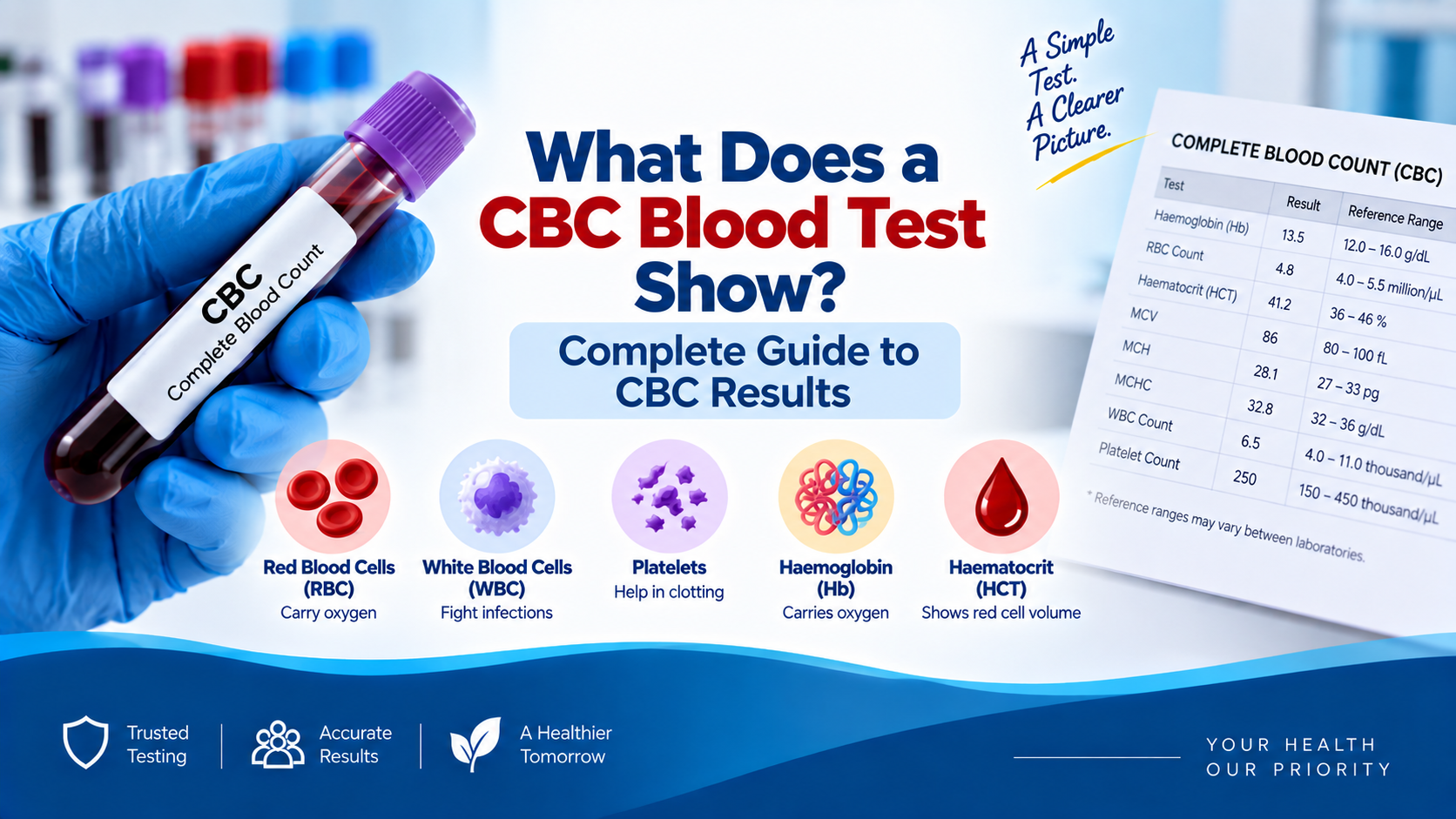
What Is a CBC Blood Test?
A CBC, or Complete Blood Count, is one of the most commonly performed blood tests.
It measures different types of cells and related measurements in your blood, including:
- Red blood cells (RBC)
- White blood cells (WBC)
- Platelets
- Haemoglobin
- Haematocrit
- Mean corpuscular volume (MCV)
A CBC can provide useful information about your general blood health and can help healthcare professionals investigate or monitor conditions such as anaemia, infections, immune-system disorders and other blood-related conditions.
However, a CBC is not a diagnosis by itself. Results need to be considered alongside your symptoms, medical history and other test findings.
Why Do Doctors Recommend a CBC Test?
A CBC may be ordered as part of a routine health check or when you have symptoms that could be related to changes in your blood.
Doctors may use a CBC to:
- Investigate unexplained tiredness or weakness
- Look for signs of anaemia
- Investigate possible infections
- Evaluate unusual bleeding or bruising
- Monitor certain medical conditions
- Monitor the effects of some treatments
- Investigate abnormal blood-cell counts
- Check changes in blood counts over time
A CBC may also be used when a healthcare professional wants to investigate symptoms such as dizziness, headaches, shortness of breath or reduced stamina.
What Does a CBC Blood Test Show?
A CBC provides information about several important components of your blood.
Let’s look at the main parameters one by one.
1. Haemoglobin (Hb)
Haemoglobin is an iron-containing protein found inside red blood cells.
Its main role is to carry oxygen from your lungs to tissues throughout your body.
What can low haemoglobin mean?
A low haemoglobin result can occur with conditions such as:
- Anaemia
- Iron deficiency
- Blood loss
- Certain nutritional deficiencies
- Some chronic medical conditions
- Certain blood disorders
Low haemoglobin may be associated with symptoms such as:
- Tiredness
- Weakness
- Dizziness
- Shortness of breath
- Headaches
However, the cause of low haemoglobin cannot usually be determined from the haemoglobin number alone. Additional tests may be needed.
What can high haemoglobin mean?
High haemoglobin can have several possible causes, including dehydration, smoking, living at high altitude and certain medical conditions. The result needs to be interpreted in context.
2. Red Blood Cell (RBC) Count
Red blood cells carry oxygen from the lungs to the rest of the body.
The RBC count measures the number of red blood cells in a given amount of blood.
An abnormal RBC count can have several possible explanations.
Low RBC count
A low RBC count may occur with:
- Anaemia
- Blood loss
- Iron deficiency
- Certain nutritional deficiencies
- Chronic medical conditions
- Bone marrow problems
High RBC count
A high RBC count can occur in situations such as dehydration, prolonged low oxygen levels, smoking or certain medical conditions.
Important: RBC count should not be interpreted separately from haemoglobin, haematocrit and the other CBC parameters.
3. Haematocrit (HCT)
Haematocrit, sometimes written as HCT or PCV, measures the percentage of your blood volume that consists of red blood cells.
For example, a haematocrit value of 42 means that approximately 42% of the blood volume consists of red blood cells.
A low haematocrit may be associated with anaemia or blood loss, while a high value can occur with dehydration and other conditions.
Haematocrit is normally interpreted together with haemoglobin and other red-cell measurements.
4. MCV — Mean Corpuscular Volume
MCV stands for Mean Corpuscular Volume.
It measures the average size of your red blood cells.
MCV can be particularly useful when investigating different types of anaemia.
Low MCV
Small red blood cells can occur with certain types of anaemia, including some cases associated with iron deficiency.
High MCV
Larger-than-usual red blood cells can occur with certain vitamin deficiencies and other medical conditions.
MCV is not interpreted on its own. Your doctor may consider it alongside haemoglobin, MCH, MCHC, RDW and other tests.
5. MCH and MCHC
Depending on your laboratory report, you may also see:
MCH — Mean Corpuscular Haemoglobin
MCH provides information about the average amount of haemoglobin in an individual red blood cell.
MCHC — Mean Corpuscular Haemoglobin Concentration
MCHC provides information about the concentration of haemoglobin within red blood cells.
These values can help healthcare professionals understand the characteristics of red blood cells and may be useful when investigating different types of anaemia.
6. White Blood Cell (WBC) Count
White blood cells play an important role in your immune system and help your body respond to infections and other conditions.
A CBC usually measures the total number of white blood cells.
A CBC with differential can provide additional information about the different types of white blood cells.
These include:
- Neutrophils
- Lymphocytes
- Monocytes
- Eosinophils
- Basophils
What can a high WBC count mean?
A high white blood cell count may occur with:
- Infections
- Inflammation
- Certain medications
- Physical or emotional stress
- Other medical conditions
What can a low WBC count mean?
A low WBC count can have several possible causes, including:
- Certain viral infections
- Medication effects
- Autoimmune conditions
- Bone marrow disorders
- Other medical conditions
A high or low WBC count does not automatically mean that you have an infection or another serious disease.
7. Platelet Count
Platelets are small blood components that help your blood clot and stop bleeding.
A CBC measures your platelet count.
What can a high platelet count mean?
An increased platelet count can occur in response to conditions such as:
- Inflammation
- Infection
- Iron deficiency
- Blood loss
- Certain medical conditions
What can a low platelet count mean?
A low platelet count can have several possible causes, including:
- Certain infections
- Medication effects
- Immune-related conditions
- Enlarged spleen
- Bone marrow disorders
The significance of an abnormal platelet count depends on the degree of abnormality and the individual’s overall health.
CBC Parameters at a Glance
| CBC Parameter | What It Measures | Why It Matters |
|---|---|---|
| Haemoglobin (Hb) | Amount of haemoglobin | Helps assess oxygen-carrying capacity and anaemia |
| RBC | Number of red blood cells | Provides information about red-cell levels |
| Haematocrit (HCT) | Percentage of blood made up of RBCs | Helps assess red-cell volume |
| MCV | Average size of red blood cells | Helps classify some types of anaemia |
| MCH | Average haemoglobin per RBC | Helps assess red-cell characteristics |
| MCHC | Haemoglobin concentration in RBCs | Provides additional red-cell information |
| WBC | Total white blood cell count | Provides information about immune and inflammatory responses |
| Platelets | Number of platelets | Important for blood clotting |
The exact parameters included in a CBC can vary somewhat depending on the laboratory and the specific test ordered.
What Is the Normal CBC Range?
This is one of the most common questions people ask after receiving a CBC report.
There is no single universal CBC reference range that applies to every person and every laboratory.
Reference ranges can vary according to factors such as:
- Age
- Sex
- Pregnancy
- Laboratory method
- Testing equipment
- Population
- Other individual factors
For example, MedlinePlus lists commonly used reference values for several CBC measurements, but also notes that normal ranges can vary between laboratories.
So, which range should you use?
Use the reference range printed on your own laboratory report.
Don’t compare your result with a random number found online without considering the units, testing method and laboratory reference range.
What Does a High or Low CBC Result Mean?
Seeing an H (High) or L (Low) next to a CBC result can be worrying.
But an H or L does not automatically mean you have a disease.
For example, a CBC result can be influenced by factors such as:
- Dehydration
- Recent illness
- Medications
- Diet
- Physical activity
- Smoking
- Pregnancy
- Menstrual blood loss
- Other health conditions
Healthcare professionals interpret the result together with your symptoms, medical history and other CBC parameters.
For more information, read our guide: How to Read a Blood Test Report: CBC, Sugar, Thyroid, Cholesterol & More.
Can a CBC Detect Anaemia?
A CBC can provide important clues about anaemia.
Haemoglobin, haematocrit, RBC count and red-cell indices such as MCV can help healthcare professionals identify patterns that may be consistent with anaemia.
However, a CBC does not always identify the underlying cause of anaemia.
Depending on the results and symptoms, your doctor may recommend additional tests such as:
- Ferritin
- Iron studies
- Vitamin B12
- Folate
- Other investigations
For example, a low haemoglobin level can have several possible causes, including iron deficiency, blood loss and certain chronic conditions.
Can a CBC Detect an Infection?
A CBC can provide information that may help doctors investigate an infection.
In particular, the WBC count and, when available, the differential count can provide useful information about white blood cells.
However, a CBC alone cannot tell you exactly which infection you have.
Doctors may need other tests depending on:
- Your symptoms
- Physical examination
- Medical history
- Type and severity of illness
- Other laboratory findings
Does a CBC Require Fasting?
Usually, no.
A standalone CBC generally requires no special preparation or fasting.
However, if your doctor has ordered a CBC together with other blood tests, some of those tests may require fasting.
For example, your doctor might order:
- CBC
- Fasting blood glucose
- Lipid profile
- Other blood tests
In this situation, the overall preparation instructions may include fasting.
If you’re unsure, ask your doctor or diagnostic laboratory before the test.
How Is a CBC Blood Test Done?
A CBC requires a small blood sample.
A healthcare professional usually:
- Cleans the area on your arm.
- Inserts a small needle into a vein.
- Collects blood into a tube or vial.
- Removes the needle.
- Applies pressure or a small dressing.
The actual blood collection generally takes only a few minutes.
You may experience a brief sting when the needle is inserted.
Minor bruising or soreness can occasionally occur afterward.
How Long Does It Take to Get CBC Results?
The time required to receive CBC results can vary depending on:
- The laboratory
- Whether the test is routine or urgent
- The testing system being used
- Whether additional tests were ordered
Your diagnostic laboratory can tell you when your report is expected to be available.
What If My CBC Result Is Abnormal?
Don’t panic if one or more CBC values are outside the reference range.
An abnormal result does not automatically mean that something serious is wrong.
Your doctor may consider:
- How far the result is outside the reference range
- Whether other CBC parameters are also abnormal
- Your symptoms
- Your age
- Your medical history
- Your medications
- Previous blood test results
Depending on the situation, your doctor may recommend:
- Monitoring the result
- Repeating the CBC
- Additional blood tests
- Other investigations
- Treatment, if a condition is identified
If a repeat blood test is recommended, it does not automatically mean that a serious disease has been found. Doctors may repeat testing simply to confirm an unexpected result or monitor a condition.
Can a CBC Diagnose Cancer?
No, a CBC cannot diagnose cancer by itself.
A CBC may reveal unusual blood-cell patterns that require further investigation, but many different conditions can produce abnormal blood counts.
If a doctor is concerned about a CBC result, they may recommend additional tests or investigations.
A CBC should therefore be viewed as one part of the diagnostic process, not a standalone cancer test.
When Should You Talk to a Doctor About Your CBC?
Speak with a healthcare professional if:
- Your CBC has several abnormal results.
- Your haemoglobin is low.
- Your WBC count is significantly abnormal.
- Your platelet count is significantly abnormal.
- You have persistent fatigue or weakness.
- You experience unexplained bleeding or bruising.
- You have persistent fever or other concerning symptoms.
- Your doctor has recommended further testing.
If you have severe or sudden symptoms such as severe breathing difficulty, fainting, chest pain or significant bleeding, seek urgent medical attention rather than relying on a blood test report for guidance.
Frequently Asked Questions About CBC Tests
What does a CBC blood test show?
A CBC measures different blood components, including red blood cells, white blood cells, platelets, haemoglobin, haematocrit and MCV. It can help healthcare professionals investigate and monitor several conditions.
Is CBC a routine blood test?
Yes. A CBC is commonly used as part of routine health assessments and is also ordered when doctors need to investigate symptoms or monitor certain conditions.
Does CBC require fasting?
Usually not. A standalone CBC generally requires no special preparation. However, fasting may be necessary if other tests are being performed at the same time.
Can CBC detect anaemia?
A CBC can provide important information that may indicate anaemia, particularly through haemoglobin, haematocrit and red-cell measurements. Additional testing may be needed to determine the cause.
Can CBC detect infection?
CBC results, particularly WBC measurements, can provide clues that may help investigate infection. However, a CBC cannot identify every infection or determine its exact cause.
What does low haemoglobin mean?
Low haemoglobin can occur with different types of anaemia, iron deficiency, blood loss and other conditions. The cause needs to be determined by a healthcare professional.
What does high WBC mean?
A high WBC count can occur with infections, inflammation, certain medicines and other conditions. It should be interpreted alongside your symptoms and other results.
What does low platelet count mean?
A low platelet count can have several causes, including infections, medication effects, immune conditions and bone marrow problems. Your doctor can determine the significance based on the overall clinical picture.
What is MCV in a CBC report?
MCV stands for Mean Corpuscular Volume and measures the average size of your red blood cells. It can help healthcare professionals classify certain types of anaemia.
What if my CBC is abnormal?
An abnormal CBC does not automatically mean you have a disease. Your doctor may review the individual values, symptoms, medical history and other test results and may recommend repeat or additional testing.
The Bottom Line
A CBC blood test is one of the most useful and commonly performed blood tests for assessing different aspects of your blood health.
It provides information about:
- Red blood cells
- Haemoglobin
- Haematocrit
- MCV and other red-cell indices
- White blood cells
- Platelets
A CBC can help investigate problems such as anaemia, infections and abnormal blood-cell counts, but it cannot diagnose every health condition on its own.
If your CBC report contains an H or L flag, don’t immediately assume that you have a serious illness. Look at the laboratory’s reference range and discuss significant or persistent abnormalities with your healthcare professional.
Your blood report is a valuable source of information—but proper interpretation requires looking at the complete clinical picture, not just one number.


