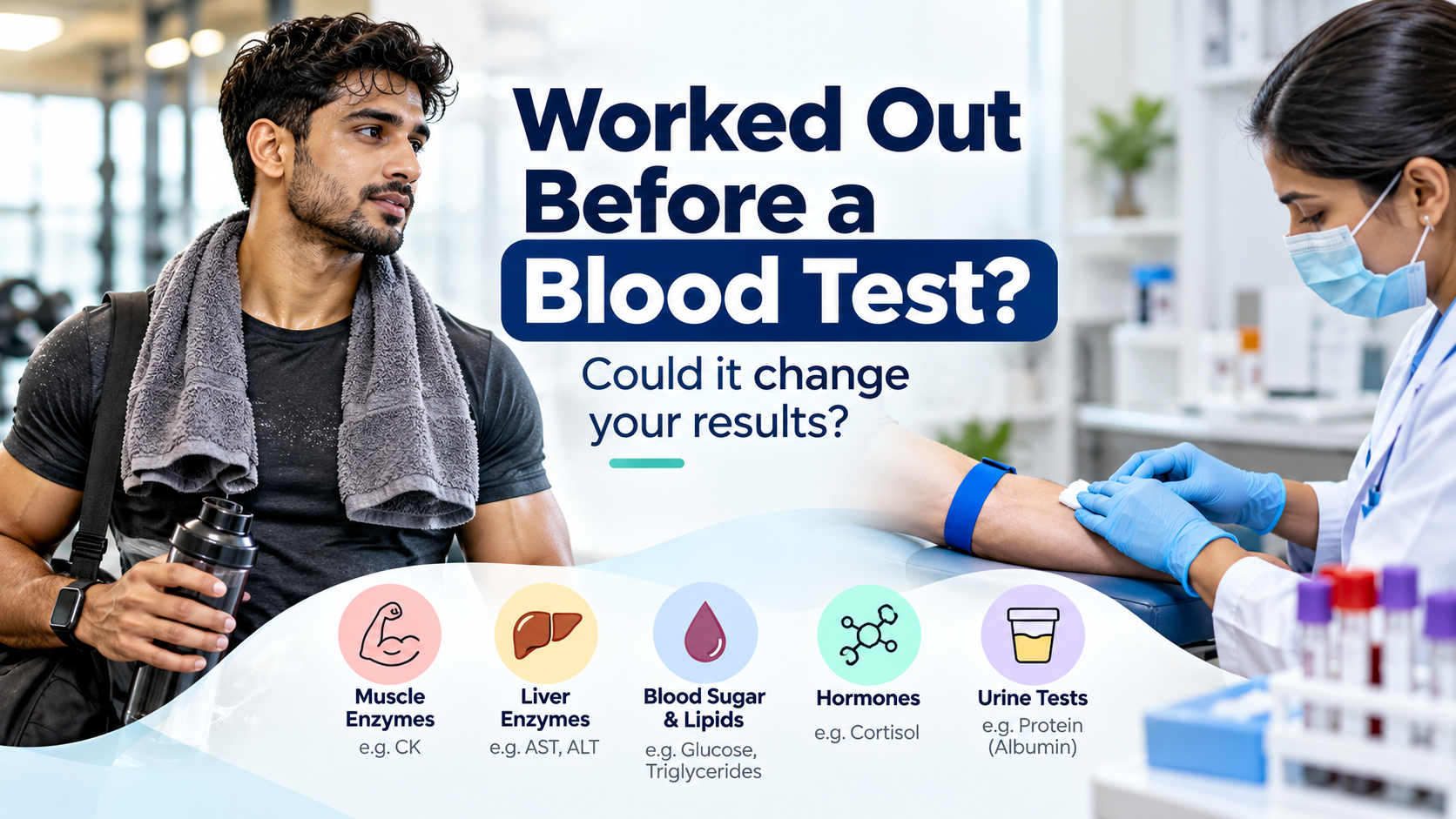
Yes, working out before a blood test can affect certain results. The effect depends on the type of exercise, how intense the workout was, how recently you exercised, and which blood test you are having.
A normal daily routine is not necessarily a problem, but a hard gym session, running, cycling, weight training or other vigorous exercise can temporarily change some substances measured in blood. This is why some blood tests require you to avoid strenuous exercise before sample collection.
Why Can Exercise Affect a Blood Test?
Exercise causes temporary changes throughout the body. Muscles use more energy, blood flow changes, and muscle cells can release certain enzymes and proteins into the bloodstream.
The intensity and duration of exercise, your fitness level and the time between exercise and sample collection can all influence laboratory measurements.
For example, strenuous exercise can temporarily increase creatine kinase (CK), an enzyme associated with muscle tissue. It can also increase certain liver-related enzymes such as AST and ALT, even when there is no underlying liver problem.
This means that exercising immediately before a test can sometimes make a result look different from your usual baseline.
Which Blood Tests Can Be Affected by Exercise?
Not every blood test is affected in the same way. Some tests are more sensitive to recent physical activity than others.
1. Creatine Kinase (CK)
CK is closely related to muscle activity. A demanding workout can cause CK levels to rise temporarily because of muscle strain. Cleveland Clinic specifically recommends limiting exercise to normal activity before a CK test when the test is being used to investigate possible muscle problems.
This is especially relevant after:
- Heavy weight training
- High-intensity workouts
- Long-distance running
- Other strenuous exercise
2. AST and ALT
AST and ALT are commonly associated with liver testing, but they are not affected only by the liver.
Intense exercise can temporarily raise AST, while demanding physical activity can also increase ALT. Because of this, recent strenuous exercise is one of the factors a healthcare professional may consider when interpreting an unexpectedly elevated result.
So, if you have done a very hard workout before an LFT or related blood test, tell your doctor or the laboratory professional.
3. Lactate
Lactate increases during physical activity because muscles produce more lactate when energy demand rises.
For this reason, people having a lactate test may be specifically instructed to avoid exercise for several hours before the test.
4. Hormone Tests
Some hormone tests require particularly controlled preparation.
For example, people undergoing cortisol testing may be asked to avoid vigorous exercise the day before because exercise can affect cortisol levels. Similarly, vigorous exercise can affect catecholamine testing, so specific preparation instructions may include avoiding strenuous physical activity.
5. Some Urine Tests
Exercise can affect some urine measurements as well.
For example, strenuous physical activity can temporarily increase urinary albumin. Quest Diagnostics advises avoiding exercise for 24 hours before certain urine albumin tests because exercise may elevate urinary albumin excretion.
What About Blood Sugar and Cholesterol Tests?
Exercise can also produce short-term changes in metabolism.
Physical activity can affect glucose metabolism and blood lipids, and research shows that an acute exercise session can produce measurable changes in glucose, insulin and free fatty acids. Exercise can also temporarily affect triglyceride levels.
This does not mean that exercise makes a blood test inaccurate. Rather, it means that your result may reflect your recent physical activity instead of your usual resting state.
For tests that require fasting, preparation instructions are particularly important. MedlinePlus advises that people who are fasting for a blood test should also avoid exercise during the fasting period unless their healthcare provider gives different instructions.
Can I Go to the Gym Before a Blood Test?
For a routine blood test, don’t assume that you need to cancel the test just because you exercised.
However, doing a hard workout immediately before sample collection is best avoided when your test instructions require you to rest or avoid strenuous exercise.
A practical approach is:
Before your test:
- Follow the exact preparation instructions provided by your doctor or laboratory.
- Avoid strenuous workouts when your test instructions say to do so.
- Don’t do heavy weight training, intense cardio or other exhausting exercise immediately before collection.
- If the test requires fasting, follow the fasting instructions carefully.
- Tell the healthcare professional if you recently completed an unusually intense workout.
What If I Already Worked Out Before My Blood Test?
Don’t panic.
One workout does not automatically mean your blood test is useless. The effect depends on what test you are having, how intense the workout was and how much time passed before the sample was collected.
The best thing to do is simply tell the person collecting your sample or your doctor:
“I exercised before the test.”
That information can be considered when interpreting the result.
In some situations, your healthcare provider may decide that no action is necessary. In others, they may recommend repeating a test after appropriate preparation.
How Long Should You Avoid Exercise Before a Blood Test?
There is no single exercise-free period that applies to every blood test.
Some tests may require avoiding exercise for several hours, while certain tests may require longer restrictions. For example, cortisol testing may involve avoiding vigorous exercise the previous day, and some urine albumin testing requires 24 hours without exercise.
That’s why it is better to follow the instructions for your specific test rather than using a generic “24-hour rule” for every blood test.
Should You Exercise the Day Before a Health Checkup?
If you’re getting a large health panel or preventive health checkup, it’s sensible to avoid an unusually intense workout immediately before the sample collection, especially when the package includes tests that can be influenced by recent exercise.
You should still follow the instructions given for your particular package or test. Some tests require fasting, while others do not. MedlinePlus recommends asking your healthcare provider or laboratory about preparation when you’re unsure.
What Should You Do Before a Blood Test?
For the most reliable result, preparation should match the specific test.
If you’re told to fast, MedlinePlus notes that fasting commonly means avoiding food and beverages other than plain water for the instructed period, often 8–12 hours, and avoiding exercise during the fasting period.
Also tell your healthcare professional about:
- Medicines you’re taking
- Vitamins or supplements
- Recent strenuous exercise
- Any preparation instructions you were unable to follow
Do not stop prescribed medicines unless your healthcare provider tells you to.
The Bottom Line
Yes, working out before a blood test can change some laboratory results, particularly after strenuous exercise. CK, AST, ALT, lactate and certain hormone or urine measurements are among the tests that can be affected by recent physical activity.
You don’t need to avoid exercise before every blood test. The important thing is to follow the preparation instructions for the specific test and tell your healthcare professional if you’ve recently done an intense workout.
When in doubt, contact the diagnostic laboratory or your healthcare provider before the sample is collected.
Frequently Asked Questions
Can I walk before a blood test?
The effect depends on the test and the intensity of activity. Follow the preparation instructions given for your test.
Can I go to the gym before a blood test?
A hard workout can affect some laboratory measurements, so avoid strenuous exercise when your test instructions require it.
Does exercise affect a CBC blood test?
Exercise can influence several laboratory variables, but the significance depends on the intensity, duration and the specific parameters being measured.
Can exercise cause high CK levels?
Yes. Intense exercise can temporarily increase CK because of muscle strain.
Can exercise raise liver enzymes?
Intense exercise can temporarily increase AST and ALT, so recent strenuous activity can be relevant when interpreting elevated results.
What should I do if I exercised before my blood test?
Tell the laboratory professional or your doctor. They can decide whether the result can be interpreted normally or whether the test should be repeated after proper preparation.