Noticing more hair on your pillow, in the shower drain, or on your comb can be worrying. And when hair fall continues, one of the first questions many people ask is:
“What blood tests should I take to find out why my hair is falling?”
The answer isn’t the same for everyone.
Hair loss can happen for many reasons, including hereditary hair loss, recent illness, significant stress, hormonal or thyroid problems, nutritional deficiencies, certain medicines, and scalp conditions. A dermatologist or doctor usually starts by looking at your hair and scalp and asking about how the hair loss started before deciding whether blood tests are necessary.
When a nutritional deficiency, thyroid disorder, or another medical cause is suspected, blood tests can help investigate the cause.
What Blood Tests May Be Considered for Hair Fall?
There isn’t one universal “hair fall blood test.” The tests depend on your symptoms, medical history, diet, age, sex, pattern of hair loss, and what your doctor finds during examination.
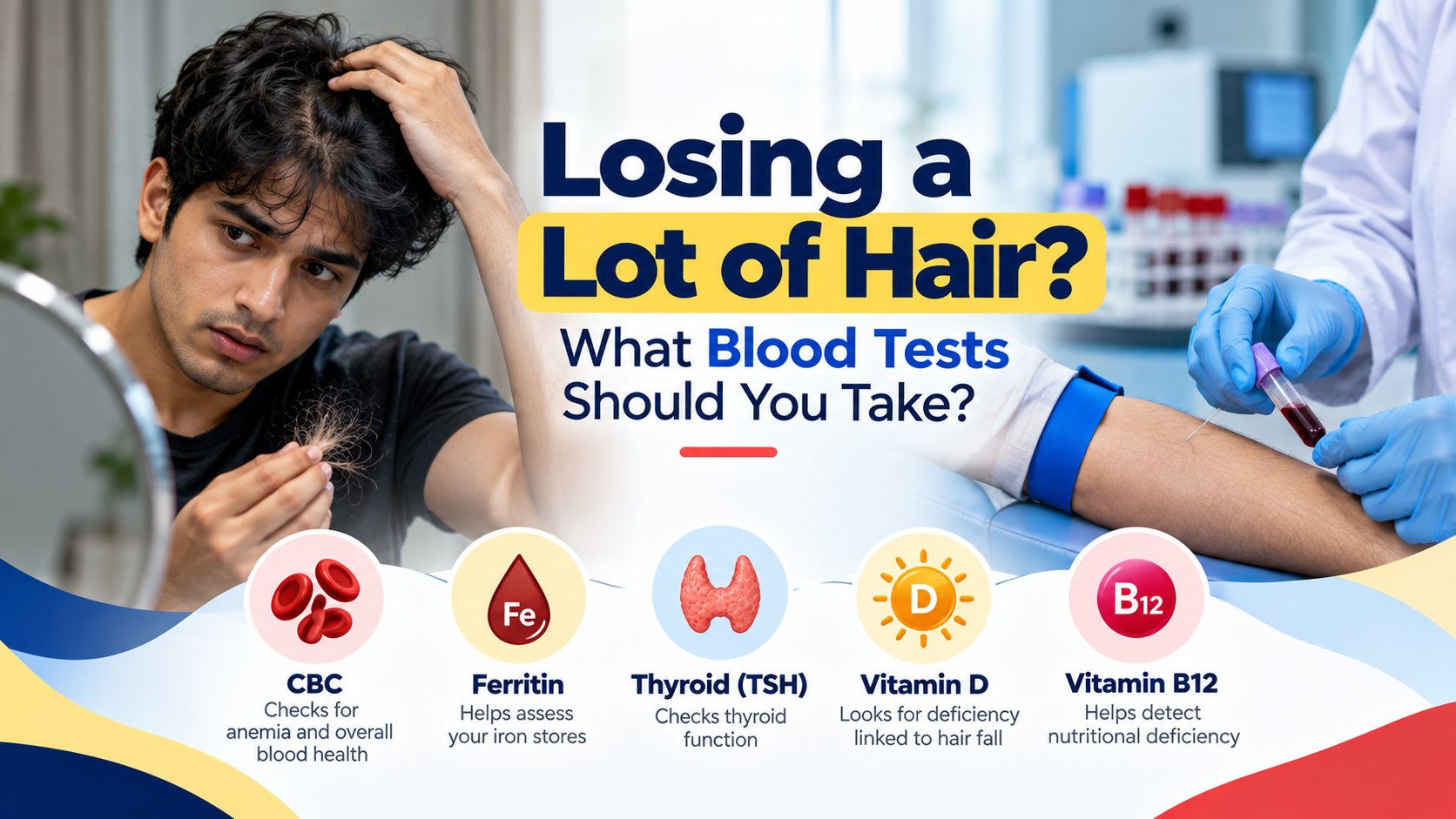
Depending on the situation, a doctor may consider tests such as:
- Complete Blood Count (CBC)
- Ferritin and other iron studies
- Thyroid function tests, particularly TSH
- Vitamin D
- Vitamin B12
- Other tests based on specific symptoms or suspected conditions
An Indian expert consensus on telogen effluvium lists CBC, routine urine examination, vitamin D and thyroid function tests among basic investigations for diffuse hair loss, while recommending more advanced tests according to the individual patient’s history and examination.
Let’s look at why some of these tests may be useful.
1. CBC — Could Anemia Be Contributing to Hair Fall?
A Complete Blood Count (CBC) measures different components of your blood, including red blood cells and haemoglobin.
Low haemoglobin can indicate anemia, and iron deficiency is one possible cause of anemia. Because nutritional deficiencies and medical conditions can contribute to diffuse hair shedding, a CBC may be included in an evaluation when your doctor suspects an underlying problem.
A CBC on its own, however, does not tell you exactly why your hair is falling.
That’s where other tests, particularly iron studies, may become relevant.
2. Ferritin — Is Your Iron Storage Low?
Ferritin is a protein that stores iron in the body. A ferritin blood test gives an indication of your body’s stored iron.
Low iron stores have been associated with diffuse hair shedding, and ferritin is commonly considered when evaluating unexplained diffuse hair loss. An Indian expert consensus specifically includes iron testing, including ferritin, among advanced investigations when iron deficiency is suspected.
This is important because someone can have hair shedding associated with low iron stores even when the question isn’t simply “Do I have anemia?”
Your doctor may therefore look at CBC + ferritin and, when appropriate, a broader iron profile rather than relying on a single number.
What can make low iron worth investigating?
Your doctor may be particularly interested in your iron status if you also have things such as:
- Fatigue or weakness
- A history of anemia
- Heavy menstrual bleeding
- A diet low in iron
- Recent blood loss
- Other symptoms suggesting iron deficiency
The result needs to be interpreted in context because ferritin can be affected by other conditions, including inflammation.
3. TSH — Could Your Thyroid Be Involved?
Your thyroid affects many body functions, and thyroid disorders can cause symptoms including fatigue, weight changes and dry or thinning hair.
A TSH (thyroid-stimulating hormone) test is commonly used to assess how well the thyroid is functioning and is often the first thyroid blood test ordered. Depending on the result and clinical situation, additional thyroid tests such as T4 or T3 may be considered.
A thyroid test may be particularly relevant when hair thinning occurs together with other symptoms suggestive of a thyroid disorder.
Don’t assume that every case of hair loss is caused by the thyroid, though. Hair loss has many possible causes.
4. Vitamin D — Should You Check It?
Vitamin D is another test that may be considered in some people with diffuse hair loss.
Research has found associations between low vitamin D levels and certain forms of hair loss, although the relationship is not simple and low vitamin D does not automatically prove that it is the cause of someone’s hair loss.
The usual blood test for assessing vitamin D status measures 25-hydroxyvitamin D [25(OH)D].
Importantly, routine vitamin D testing is not recommended for everyone. Whether testing makes sense depends on the individual and the clinical reason for testing.
5. Vitamin B12 — When Could It Be Relevant?
Vitamin B12 is involved in healthy red blood cell formation and normal neurological function.
A B12 blood test may be considered when your doctor suspects B12 deficiency based on your symptoms, diet or other findings. An Indian expert consensus lists B12 as an advanced investigation rather than something that automatically needs to be tested in every person with hair loss.
Research on B12 and hair loss has produced mixed results. One study of people with diffuse hair loss found lower ferritin and vitamin D levels but did not find a significant difference in B12 levels between the hair-loss and control groups.
So, B12 can be relevant in selected cases, but “hair fall = B12 deficiency” is too simplistic.
Do I Need All These Tests?
Not necessarily.
This is one of the biggest mistakes people make after searching online.
Seeing a list of 10 possible tests doesn’t mean you should order all 10.
A dermatologist or doctor may be able to identify the likely type of hair loss from:
- The pattern of thinning
- How quickly it started
- Whether hair is shedding from the whole scalp or from specific areas
- Your scalp condition
- Family history
- Recent illness or fever
- Diet and weight changes
- Stress
- Medicines and supplements
- Menstrual or hormonal history, where relevant
The American Academy of Dermatology notes that a dermatologist may order blood tests when a disease, vitamin deficiency or hormone imbalance is suspected.
For some common types of hereditary hair loss, the diagnosis may be made mainly from the scalp and hair examination rather than from a large set of blood tests.
What If I’m Losing Hair After a Fever or Illness?
This is another situation where the timeline matters.
Some people notice significant hair shedding a few months after a major illness, high fever, surgery or another physical stressor. This can happen with a type of shedding called telogen effluvium.
If the hair shedding began after an illness, your doctor may consider that history alongside your examination and, when appropriate, blood tests.
That doesn’t necessarily mean you have an iron or vitamin deficiency.
What If I’m Losing Hair Suddenly?
Sudden or unusual hair loss deserves proper evaluation rather than simply starting supplements.
For example, hair loss can sometimes appear as:
- A bald patch
- Rapidly increasing thinning
- Noticeable clumps of hair coming out
- A suddenly widening part
- A receding hairline
- Eyebrow or body-hair loss
- Hair loss associated with scalp itching, pain, scaling or inflammation
The American Academy of Dermatology notes that hair loss can appear suddenly and that different patterns can have different causes.
A blood test may help in some cases, but a scalp examination can be equally important.
What About Hair Supplements?
It can be tempting to buy a “hair vitamin” immediately after noticing hair fall.
That’s not always the right move.
Supplements are useful when a deficiency actually exists or when a healthcare professional recommends them for a specific reason. Taking large amounts of vitamins or minerals without knowing whether you need them can be unnecessary and, with some nutrients, potentially harmful.
A better approach is:
Find the possible cause → test when appropriate → treat the underlying problem.
The American Academy of Dermatology similarly emphasizes identifying the cause of hair loss before deciding on treatment.
So, Which Blood Tests Should You Ask About?
There is no one-size-fits-all package, but depending on the type of hair loss and your symptoms, a doctor may consider:
| Test | Why it may be considered |
|---|---|
| CBC | Looks for anemia and other blood abnormalities |
| Ferritin | Gives information about stored iron |
| Iron profile | Provides a broader assessment of iron status |
| TSH / thyroid function tests | Checks for possible thyroid dysfunction |
| Vitamin D | May be considered when deficiency is suspected or clinically relevant |
| Vitamin B12 | May be considered when deficiency is suspected |
| Other tests | Selected according to your symptoms, history and examination |
The important point is that these are possible investigations, not a checklist that every person with hair fall needs.
Do I Need to Fast for Hair Fall Blood Tests?
That depends on the tests being ordered.
Some individual tests don’t require fasting, while other tests ordered at the same time may have specific preparation requirements. For example, TSH testing itself generally doesn’t require special preparation, while preparation for other blood tests may be different.
Always follow the preparation instructions provided by your doctor or diagnostic laboratory.
If several tests are being performed together, ask what preparation is required for the complete set of tests, rather than assuming that all blood tests require fasting.
When Should You See a Doctor About Hair Fall?
Consider getting medical advice when hair loss is:
- Sudden or rapidly progressing
- Causing visible bald patches
- Associated with scalp pain, scaling or inflammation
- Accompanied by other symptoms such as significant fatigue, unexplained weight change or menstrual irregularities
- Continuing or becoming noticeably worse
A dermatologist can determine whether you’re experiencing actual hair loss, excessive shedding, or a combination of both and can decide whether laboratory testing is appropriate.
The Bottom Line
If you’re losing a lot of hair, don’t automatically order every vitamin and hormone test you can find online.
Hair loss has many possible causes, and the right investigation depends on the pattern of hair loss and your individual history.
Depending on the situation, a doctor may consider CBC, ferritin/iron studies, thyroid testing, vitamin D, vitamin B12 or other targeted tests.
The goal of testing is