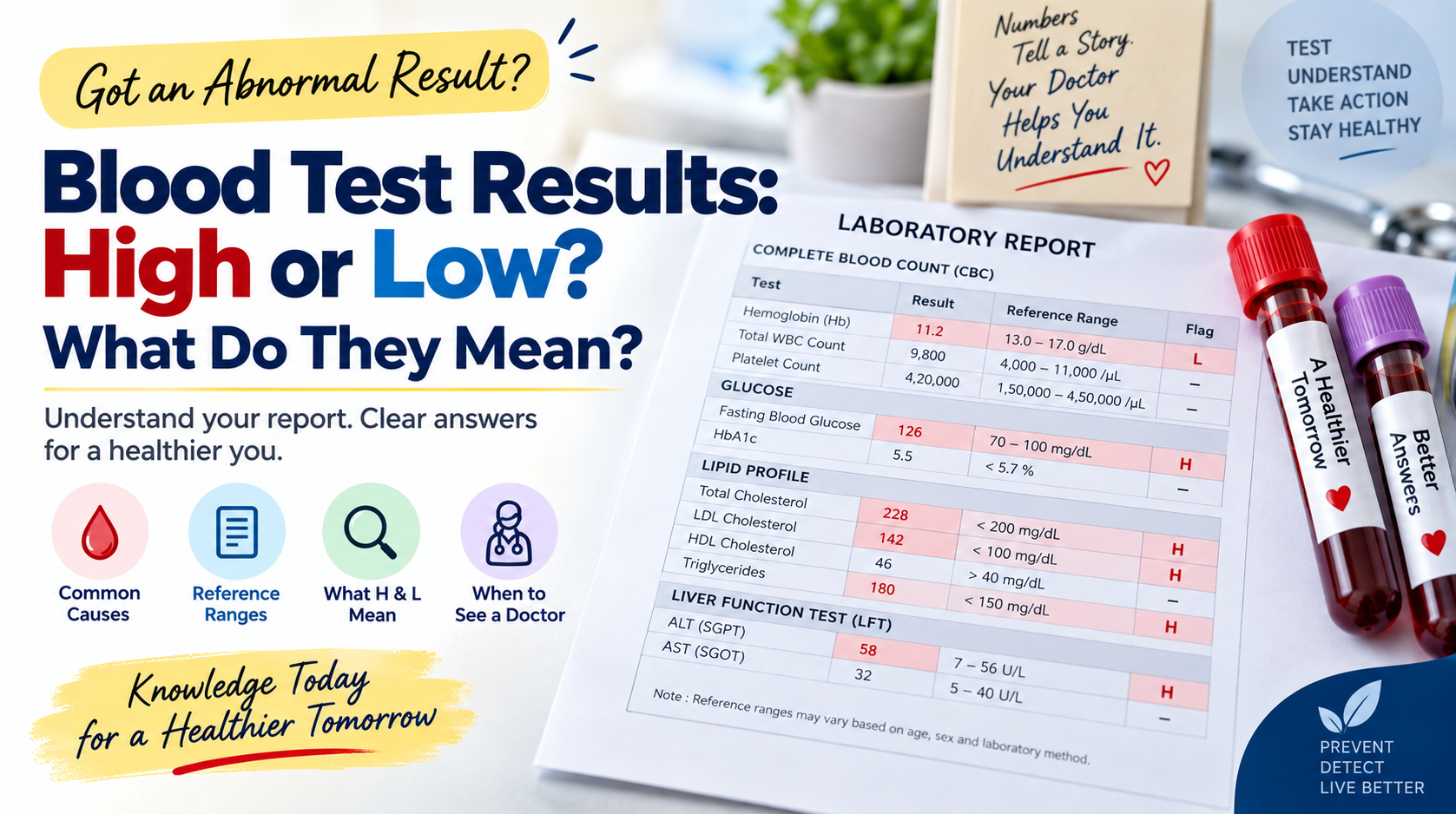
Why Is My Blood Test Result High or Low? What It Can Mean
Have you ever received your blood test report and noticed an H (High) or L (Low) beside one of your results?
You may have wondered:
- Is my blood test normal?
- What does a high or low result mean?
- Does an abnormal blood test mean I have a disease?
- Should I repeat the test?
- Do I need to see a doctor?
These are common questions after receiving a laboratory report.
Blood tests are valuable tools that help doctors understand different aspects of your health. They can provide information about blood cells, blood sugar, cholesterol, thyroid function, liver health, kidney function, and other important body processes.
However, one abnormal blood test result does not automatically mean that you have a serious medical condition.
The meaning of a result depends on the test, the laboratory’s reference range, your symptoms, medical history, and other findings.
In this guide, we’ll explain what high and low blood test results mean, why they can happen, and what you should do after receiving an abnormal report.
What Does an Abnormal Blood Test Result Mean?
A blood test result is generally considered abnormal when it falls outside the reference range provided by the laboratory.
For example, your report may show:
| Test | Your Result | Reference Range | Flag |
|---|---|---|---|
| Haemoglobin | 11.0 g/dL | Laboratory-specific | L |
| Glucose | 135 mg/dL | Laboratory-specific | H |
| TSH | 6.0 mIU/L | Laboratory-specific | H |
These are illustrative examples, not diagnostic cutoffs or actual patient results.
The letters H and L generally indicate that the result is above or below the laboratory’s reference range.
But remember: a result outside the reference range is not always a sign of illness. Reference ranges are based on statistical distributions, and healthy people can sometimes have results outside them. (MedlinePlus )
What Do H and L Mean in a Blood Test Report?
This is one of the most common questions people ask when reading their reports.
H = High
An H generally means your result is higher than the laboratory’s stated reference range.
For example, a blood test may show a high:
- Blood glucose level
- Cholesterol level
- White blood cell count
- ALT or AST
- TSH
- Creatinine
The meaning depends on which test is elevated.
L = Low
An L generally means your result is below the laboratory’s stated reference range.
Examples include:
- Low haemoglobin
- Low platelet count
- Low blood glucose
- Low sodium
- Low vitamin B12
- Low albumin
Again, a low result does not automatically mean a disease is present.
Always look at the test name and reference range before interpreting the result.
Why Can Blood Test Results Be High or Low?
There are many possible reasons for an abnormal result.
1. Normal Biological Variation
Your body does not maintain every blood measurement at one fixed number.
Results can vary depending on factors such as:
- Age
- Sex
- Time of day
- Recent food intake
- Hydration
- Exercise
- Hormonal changes
- Normal differences between individuals
Some healthy people may naturally have values outside a particular reference range.
2. Fasting or Recent Meals
Some blood tests are affected by recent food intake.
For example, blood glucose and triglyceride measurements can be influenced by eating.
This is why certain tests may require fasting, while others do not.
Read our related guide: CPL Diagnostics — and link this section to your fasting-before-blood-test article in WordPress.
3. Medicines and Supplements
Certain medicines and supplements can influence laboratory results.
For example, some medications may affect:
- Liver enzymes
- Kidney function measurements
- Blood glucose
- Thyroid test results
- Electrolytes
Never stop prescribed medication on your own because of an abnormal test result. Discuss it with your doctor.
4. Recent Illness or Infection
An infection or recent illness can temporarily affect certain blood measurements.
For example, white blood cell counts may change during infections.
Your doctor may recommend monitoring or repeating a test depending on the circumstances.
5. Underlying Health Conditions
Abnormal results can sometimes be associated with medical conditions.
Examples include:
- Anaemia
- Diabetes
- Thyroid disorders
- Kidney disease
- Liver disease
- Nutritional deficiencies
However, blood tests alone do not always establish a diagnosis.
Common Blood Test Results That May Be High or Low
1. High or Low Haemoglobin
Haemoglobin is a protein in red blood cells that carries oxygen.
A haemoglobin test is commonly included in a CBC (Complete Blood Count).
What can low haemoglobin mean?
Low haemoglobin may be associated with anaemia.
Possible causes include:
- Iron deficiency
- Vitamin B12 deficiency
- Blood loss
- Certain chronic conditions
- Other medical causes
Symptoms of anaemia may include tiredness, weakness, and shortness of breath, although some people may have no obvious symptoms.
What can high haemoglobin mean?
A high haemoglobin result may be associated with factors such as dehydration, smoking, living at high altitude, or certain medical conditions.
The result needs to be interpreted alongside other CBC parameters and clinical history.
Important: A haemoglobin value cannot be interpreted correctly without considering the laboratory’s reference range and the individual.
2. High or Low White Blood Cell Count
White blood cells help the body fight infections and participate in immune responses.
A CBC measures the total white blood cell count, and a differential may provide information about different types of white blood cells.
What can a high WBC count mean?
A high white blood cell count may occur with:
- Infections
- Inflammation
- Certain medications
- Other medical conditions
What can a low WBC count mean?
A low white blood cell count may be associated with:
- Certain viral infections
- Medication effects
- Bone marrow conditions
- Other medical causes
A CBC result should be interpreted with the rest of the report and the person’s symptoms.
3. High or Low Platelet Count
Platelets help your blood clot.
A platelet count is part of a CBC.
What can a high platelet count mean?
A high platelet count can occur in response to inflammation, infection, iron deficiency, or other conditions.
What can a low platelet count mean?
A low platelet count may be associated with infections, medication effects, immune conditions, or other causes.
A very low platelet count or symptoms such as unusual bleeding require prompt medical assessment.
4. High Blood Sugar or HbA1c
Blood glucose and HbA1c are commonly used to assess blood sugar.
What does high blood sugar mean?
High blood glucose may be associated with:
- Diabetes
- Prediabetes
- Recent food intake
- Stress or illness
- Certain medications
The meaning depends on the type of glucose test, whether fasting was required, and the actual result.
What does high HbA1c mean?
HbA1c reflects average blood glucose over approximately the previous 2–3 months.
Common diagnostic categories for adults are:
| HbA1c | Interpretation |
|---|---|
| Below 5.7% | Normal |
| 5.7%–6.4% | Prediabetes range |
| 6.5% or higher | Diabetes range |
These categories are used for screening and diagnosis, but a healthcare professional may recommend confirmation or additional testing. (CDC )
Related article
Link to your existing article:
HbA1c Test: Normal Range, Results, Levels and What They Mean
5. High or Low Cholesterol
A lipid profile measures different fats in the blood.
It may include:
- Total cholesterol
- LDL cholesterol
- HDL cholesterol
- Triglycerides
What does high LDL cholesterol mean?
High LDL cholesterol can contribute to the development of plaque in arteries and increase cardiovascular risk.
However, the meaning of a cholesterol result depends on your overall risk factors, not just one number.
What does low HDL mean?
HDL is often called “good cholesterol” because it helps transport cholesterol away from certain tissues.
HDL is only one part of cardiovascular risk assessment.
Your doctor may consider cholesterol levels along with blood pressure, diabetes, smoking, age, and family history.
6. High or Low TSH
TSH stands for thyroid-stimulating hormone.
It is commonly measured when evaluating thyroid function.
What does high TSH mean?
High TSH can be associated with an underactive thyroid, also called hypothyroidism.
However, TSH should be interpreted with other thyroid tests, particularly free T4 when indicated.
What does low TSH mean?
Low TSH may occur in some people with an overactive thyroid, or hyperthyroidism.
It can also occur in other situations, including certain medication effects.
A TSH result alone is not always enough to diagnose a thyroid disorder.
7. High or Low Creatinine
Creatinine is a waste product produced by normal muscle metabolism.
It is commonly measured as part of kidney function testing.
What can high creatinine mean?
High creatinine may be associated with reduced kidney filtration, but it can also be affected by factors such as:
- Muscle mass
- Dehydration
- Certain medicines
- Recent strenuous exercise
- Other medical conditions
What can low creatinine mean?
Low creatinine may be associated with low muscle mass or other factors.
Doctors often consider creatinine alongside eGFR and other clinical information when assessing kidney function.
Read more in your KFT article: Kidney Function Test: Creatinine, Urea and eGFR Explained.
8. High or Low Liver Enzymes
Liver-related blood tests may include:
- ALT/SGPT
- AST/SGOT
- Bilirubin
- Alkaline phosphatase
- Albumin
What does high ALT or AST mean?
Elevated liver enzymes can occur for various reasons, including liver injury, medication effects, muscle-related causes, and other conditions.
A high result does not automatically mean a person has a serious liver disease.
Doctors consider the degree of elevation, other liver-related tests, symptoms, and medical history.
Does One Abnormal Blood Test Mean You Have a Disease?
No.
An abnormal result is a finding that may need explanation, monitoring, or further investigation.
For example:
- One mildly elevated value may not be clinically significant.
- A result may be affected by recent illness.
- The laboratory reference range may differ from another laboratory’s range.
- A result may need to be interpreted alongside related parameters.
Doctors do not generally diagnose a condition based on an isolated number without considering the overall clinical picture.
This is why self-diagnosing from a blood test report can be misleading.
What Is a Reference Range in a Blood Test?
A reference range is the range of values that a laboratory uses to help interpret a test result.
It is important to understand that:
Reference ranges can differ between laboratories, testing methods, and populations.
For this reason, always use the reference range printed on your own report.
Do not compare your result with a random number found on the internet without considering the test method and units.
Example
If one laboratory uses a reference range of 0.4–4.0 mIU/L for TSH and another uses a slightly different range, the interpretation may not be identical.
The range printed on your report is the appropriate starting point.
Should You Repeat a Blood Test If the Result Is Abnormal?
Sometimes, yes.
Your doctor may recommend repeat testing when:
- The result is unexpected.
- The abnormality is mild.
- You recently had an illness.
- The test may have been affected by preparation.
- Confirmation is needed.
- The result needs to be monitored over time.
However, not every abnormal result needs to be repeated, and not every result should be ignored.
The right next step depends on the specific test, how abnormal it is, your symptoms, and your medical history.
When Should You Consult a Doctor About an Abnormal Blood Test?
You should discuss unexpected or concerning results with your healthcare professional.
Seek prompt medical assessment if you have symptoms such as:
- Chest pain
- Severe breathlessness
- Fainting
- Unusual or heavy bleeding
- Severe weakness
- Confusion
- Other sudden or serious symptoms
A blood test report should not be used to delay urgent medical care.
If you have no symptoms but your report contains abnormal results, contact your doctor to understand whether follow-up testing is needed.
How to Read Your Blood Test Report Correctly
Follow these simple steps.
Step 1: Identify the test
Is it CBC, HbA1c, lipid profile, TSH, LFT, KFT, or another test?
Step 2: Check your actual result
Look at the value and unit.
Step 3: Check the reference range
Use the range printed on your report.
Step 4: Look at the flags
H and L can help identify results outside the reference range.
Step 5: Review related parameters
Many tests are interpreted together.
Step 6: Consider symptoms and history
Your doctor will consider the whole picture.
Step 7: Discuss the result
Ask whether you need repeat testing, additional investigations, or monitoring.
Frequently Asked Questions About Abnormal Blood Test Results
What does H mean in a blood test?
H generally means that a test result is higher than the laboratory’s reference range.
What does L mean in a blood test?
L generally means that a result is lower than the laboratory’s reference range.
Is an abnormal blood test always serious?
No. An abnormal result may occur for many reasons, including normal biological variation, recent illness, medication effects, or an underlying condition.
Can a blood test be abnormal even if I feel healthy?
Yes. Some conditions may not cause noticeable symptoms, and some abnormal results may not indicate disease. Your doctor can assess whether follow-up is needed.
Should I worry if only one blood test is high?
Not necessarily. The importance depends on which test is high, how much it is elevated, and your overall health.
Can a blood test detect every disease?
No. Blood tests are important diagnostic tools, but some conditions require urine tests, imaging, physical examination, or other investigations.
Can I compare my blood test result with someone else’s?
It is better to avoid direct comparisons. Reference ranges and individual health circumstances can differ.
What should I do if my blood test report is abnormal?
Discuss the result with your doctor. They can determine whether you need repeat testing, additional investigations, or monitoring.
Conclusion
Seeing a high or low value on your blood test report can be worrying, but an abnormal result does not automatically mean that you have a disease.
Blood tests such as CBC, HbA1c, lipid profile, thyroid tests, liver function tests, and kidney function tests provide useful information about different aspects of your health.
The correct interpretation depends on the laboratory reference range, the actual result, your symptoms, medical history, and other test findings.
If your report contains an unexpected result, don’t panic and don’t self-diagnose.
Discuss your report with a qualified healthcare professional and follow their advice about any further testing or treatment.
Understanding your blood test results is an important step toward making informed decisions about your health.